
StatusCake alternative for agencies: a good free tier with three catches
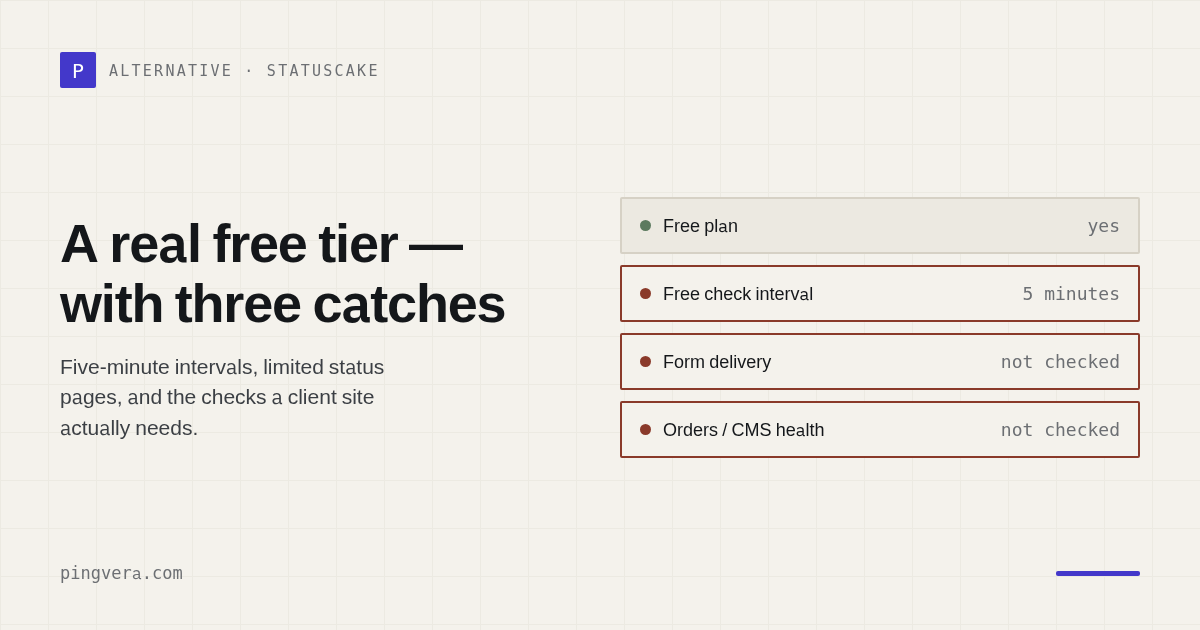
StatusCake deserves more respect than most "alternative" pages give it. It has a real free plan — not a trial — it monitors SSL, domains and page speed, and it does the one thing that separates a usable monitor from a noisy one: it confirms an outage before alerting you. So this page is not going to tell you it's bad. It's going to tell you where it doesn't fit an agency, which is a different and more useful thing.
Three catches worth knowing before you commit a portfolio
1. The free tier checks every five minutes
Ten monitors, free, forever — that's genuinely generous. The interval is five minutes.
Five minutes is the industry's favourite blind spot. An outage that lasts two minutes — a PHP-FPM pool exhausting itself, a bad deploy rolled back quickly, a database deadlock — can fall entirely between two checks. No alert. A clean uptime graph. Your client, however, was watching their site throw errors, and they will remember that you weren't.
Our checks run every minute on every plan, free included. It doesn't eliminate the blind spot — nothing short of continuous observation does — but it shrinks it fivefold, and it doesn't require a card.
2. Status pages are a separate product
This one surprises agencies mid-plan. StatusCake's status pages aren't part of the monitoring tiers — they're a separate paid product with their own ladder, starting around €11.63/month, and removing StatusCake's own branding requires the top status-page tier.
If your pitch to a client includes "you'll get a branded status page at status.yourdomain.com", that is a second subscription, on top of monitoring, per your agency — and un-branding it costs the most. Ours are white-label with a custom domain, included.
3. The entry paid plan has one team seat
The Superior plan — the one most freelancers and small studios would land on — includes one team member. Nine come with Business, roughly three and a half times the price.
For a solo freelancer that's fine. For a three-person studio where a developer and an account manager both need to see whether a client's site is up, you're either sharing a login (and giving up any audit trail of who acknowledged what) or paying for the tier above.
Check a site from several regions right now
Availability from Europe and the US, SSL, domain expiry and WordPress health — free, no sign-up.
Check a siteWhat both of us miss, and what only one of us covers
Now the part that actually matters, and I want to be precise about it, because it is easy to be unfair here.
StatusCake monitors the website, and does it well: HTTP, TCP, DNS, SMTP, ping, page speed, SSL validity and mixed content, domain expiry and blacklists, servers. That is a complete and competent picture of a website's technical health, and if that is what you need, it is a good tool at a fair price.
It does not monitor the business the website is doing. Neither does Pingdom, or Site24x7, or UptimeRobot. This is not a flaw in StatusCake specifically — it is the shape of the entire uptime-monitoring category. And it is precisely where client relationships are lost:
- The contact form stopped delivering leads. The page loads, the form submits, the "thanks" message appears — and the email is being dropped somewhere between wp_mail() and the inbox. An SMTP port check confirms the mail server is listening. It says nothing about whether the lead arrived.
- The store stopped taking orders. A gateway left in test mode, a checkout broken by a plugin update, or bots grinding stolen cards through the checkout while the revenue dashboard shows nothing, because WooCommerce excludes failed orders from Analytics by default.
- WordPress is quietly rotting. A dead WP-Cron means backups haven't run in months. Modified core files mean a backdoor. Neither produces a single failed HTTP check.
Each of those returns 200 OK, forever, while your client's revenue quietly stops.
Side by side
| StatusCake | Pingvera | |
|---|---|---|
| Free tier | 10 monitors, 5-minute interval | 5 sites, 1-minute interval |
| Confirms before alerting | Yes — configurable confirmation tests | Yes — quorum across regions |
| SSL + domain expiry | Yes (plus blacklist checks) | Yes |
| Page speed | Yes | No |
| Server monitoring | Yes (paid tiers) | Yes — optional agent |
| Status pages | Separate paid product; un-branding on top tier | Included, white-label, custom domain |
| Team seats on entry paid plan | 1 | Multiple, with roles |
| Form lead delivered to inbox | No | Yes |
| WooCommerce order monitoring | No | Yes |
| WordPress health from inside | No | Yes |
| Client report | Reporting; white-label on paid tiers | White-label, business-language, immutable snapshot |
One clarification, in fairness: StatusCake does offer white-label reporting on its paid plans, and so does Site24x7's MSP tier. So "nobody else has white-label reports" would be untrue, and we won't say it. The difference is not the branding on the report — it's what's inside it. Theirs report uptime and performance. Ours reports whether the client's business worked: leads delivered, orders taken, threats found, certificates renewed, work performed. Different document, same logo.
Who should stay, who should switch
Stay with StatusCake if you mainly need technical monitoring of your own sites, you want page-speed tracking, and one seat is enough. It's a fair product at a fair price and there's no shame in it.
Look at us if you run other people's sites for money: if what ends your client relationships isn't a slow homepage but a lead that never arrived, an order that never came, or a hack nobody noticed. And if the artefact that justifies your retainer is a monthly report the client can actually read — not a graph of response times.
FAQ
What are the free plan's limits?
Ten uptime monitors at a 5-minute interval, one SSL monitor (daily), one domain monitor (weekly), one page-speed test a day. No custom locations, no white-label reporting, no team members. Genuinely usable — the interval is the catch.
Are status pages included?
No — they are a separate paid product with their own plans, starting around €11.63/month, and removing StatusCake branding requires the top status-page tier.
Does StatusCake confirm outages before alerting?
Yes — confirmation tests re-check before an outage is declared, and the count is configurable. Credit where due: this is what prevents the false-alert floods that plague cheaper monitors.
What doesn't it monitor?
The business paths: form leads reaching the inbox, stores still accepting orders, WordPress core integrity. Those failures all return a perfectly healthy 200.
Watch the business, not just the page
One-minute checks on every plan, multi-region confirmation, form delivery to the inbox, WooCommerce orders, WordPress health, and white-label status pages included. Free for up to 5 sites.
Start freeRead next: Pingdom alternative for agencies: no free tier, and the bucket problem · Freshping alternative for agencies: it shuts down March 6, 2026 · UptimeRobot alternative for agencies: what client work actually needs · Monitoring as Code for Web Agencies · Run a free site check.