
Ecommerce Technical Debt: Prioritise It by Business Risk
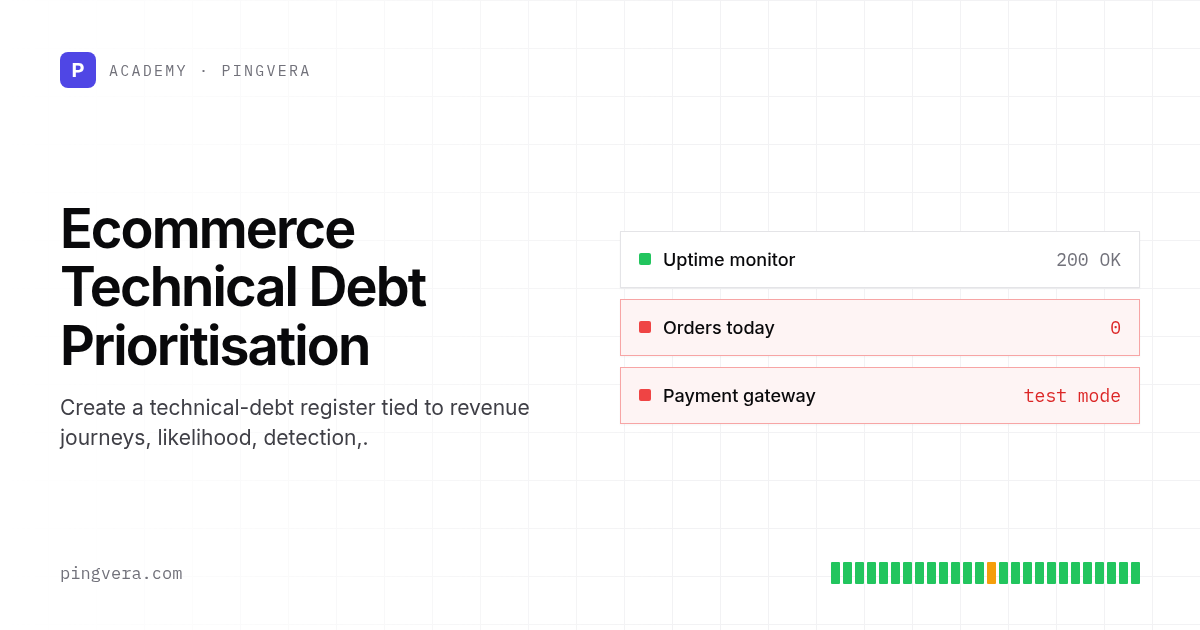
Technical debt is not every inelegant piece of code. It is a decision or condition that increases the cost and risk of future change, operation, or recovery. Discuss it through commercial consequences: lost orders, incorrect money states, exposed data, slow releases, or dependence on one specialist.
Do not attempt to “pay all debt.” Maintain a register tied to critical journeys and reserve capacity for work whose cost of delay and risk exposure exceed the cost of treatment.
At a glance
- describe observable condition rather than calling something legacy;
- connect debt to a component and business journey;
- assess likelihood, impact, and detection speed;
- include how frequently the area changes;
- separate security risk from developer inconvenience;
- add tests, observability, or a fallback as treatment options;
- name an owner and review trigger;
- remove items that no longer matter.
Copyable debt record
Title:
Component and owner:
Observable condition:
Original context or decision:
Affected business journey:
Credible failure scenario:
Impact:
How quickly would we detect it?
How would we recover?
Change frequency:
Options: accept / mitigate / repair / replace:
Estimate and dependencies:
Next decision date:
Without a consequence scenario, “rewrite the module” cannot compete fairly for investment.
Score decision factors
Use a consistent one-to-five scale:
| Factor | Question |
|---|---|
| Impact | What happens to money, customers, or data? |
| Likelihood | Do incidents and weak signals support the scenario? |
| Exposure | How often is the path used or changed? |
| Detectability | Will the team know before the customer? |
| Recoverability | Is rollback, workaround, and skill available? |
| Cost of delay | What worsens if the business waits a quarter? |
| Effort | What does safe treatment require? |
A formula can aid ordering but must not hide critical classes. A serious vulnerability needs a security response rather than waiting for its composite backlog score.
Choose one of four treatments
- Accept: understood, low exposure, named owner, review date.
- Mitigate: monitoring, feature flag, fallback, or change restriction.
- Repair: targeted redesign with a testable completion condition.
- Replace: component blocks the business and migration is justified.
One strong control can sometimes reduce more risk than an immediate full rewrite.
Review customer journeys, not repositories
Walk through product and price, search and PDP, basket and promotion, delivery, payment, order/ERP, return, account, analytics, and product feeds.
For each, ask which component fails repeatedly, resists testing, lacks ownership, relies on unsupported versions, or requires manual recovery. Link relevant incidents and change lead time to the record.
Reserve capacity
Use a persistent capacity allocation or explicit risk budget. The exact percentage depends on context; the essential control is that risk work is not cancelled every sprint for an unexamined feature.
Monthly review:
- new incidents and changed exposure;
- current top five risks;
- treatment decisions and evidence;
- debt that can be removed with roadmap work;
- overdue security and recovery actions;
- obsolete records to close.
Define “done”
“Code rewritten” is insufficient. Completion may require data migration, regression coverage, removal of the old path, documentation, monitoring, load evidence, and a verified rollback.
Common mistakes
- labelling any disliked technology as debt;
- rewriting without a measurable outcome;
- considering engineering effort only;
- ignoring detection and recovery;
- collecting ownerless backlog entries;
- omitting future change frequency;
- assuming a new stack has no debt;
- closing before the old path is retired.
FAQ
How should debt be explained to a founder?
Use scenario, likelihood, impact, cost of delay, and treatment options. “Old code” is weak; “each price update can disable checkout for two hours” is decision-ready.
Must feature work stop?
Sometimes for a critical risk. More often, maintain capacity, pair treatment with roadmap work, and use explicit thresholds rather than an occasional unbounded refactoring month.
What if probability is unknown?
Use a range and confidence level, supported by incidents and expert scenarios. False numerical precision does not improve prioritisation.
Sources
Reviewed: 3 September 2026.
Continue with the replatforming checklist, platform selection, and dependency mapping.
Pingvera can make part of the debt observable by showing failure frequency, detection time, and critical-journey stability.
Know about problems before your customers do
Pingvera watches whether an online business actually works — uptime, checkout, orders, domain, SSL and server — and alerts you in Telegram, email or a webhook before a customer has to tell you.
Start freeRead next: Ecommerce Replatforming Checklist · Ecommerce Returns Economics · How to Monitor Ecommerce Integrations · CAC Payback Period for Ecommerce · Run a free site check.
Read next: Ecommerce Replatforming Checklist · Ecommerce Returns Economics · How to Monitor Ecommerce Integrations · CAC Payback Period for Ecommerce · Run a free site check.